University of North Texas Athletics
Examining The Legacy Of Rick Villarreal
6/20/2016 12:00:00 AM | Mean Green Athletic Fund
by David Pyke
North Texas Athletics Communications
May 23 was one of those sleepy Mondays when nothing particularly interesting was expected. The last games of 2015-16 had been played, classes were out, the parking lots were deserted, graduation was done, and a quiet emptiness had settled over the campus.
The only thing out of the ordinary was an email telling everyone in the athletic department to report to the team meeting room at 9:40 a.m.
That Monday morning's revelation that Rick Villarreal was stepping down as North Texas' athletic director came as shock to everyone in the room. I knew retirement was on his mind, and had spoken with him briefly on the subject. It was something he was clearly planning for his near future.
Nevertheless, Villarreal's emotional announcement turned the day upside down, and left the staff in stunned silence.
Monday, June 20, was Rick's last day as the Mean Green's AD. But before North Texas turns the page and president Neal Smatresk embarks in earnest on the task of finding a successor, it seems appropriate to address a question:
What is the legacy of Rick Villarreal?
There were great moments: the first trip to a bowl game in more than 40 years, four-straight bowl appearances, two trips to the men's NCAA basketball tournament, a New Year's Day bowl victory, and 31 conference championships across eight sports. More than 70 student-athletes who played at North Texas during the Villarreal era went on to play professional sports.
But under Villarreal, the Mean Green had a record of 488-602 in the marquee sports, football and basketball. The football program was 65-117, a 36.7 winning percentage. Men's basketball had a winning record (244-219), but women's basketball was 179-266, a 40.2 winning percentage. The hirings and the failures of coaches Todd Dodge, Shanice Stevens and Mike Petersen (who were a combined 59-165) and the searing memory of the 1-11 2015 football season - punctuated by a 66-7 homecoming loss to Portland State - are stains on Villarreal's tenure.
They do not, however, tell the entire story.
The legacy of Rick Villarreal is evident across the athletic department's landscape, which was completely overhauled in the last 15 years.
To fully grasp the magnitude of the reimagining of Mean Green athletics, go back the days before Villarreal arrived.
The attitude towards athletics at North Texas was very different in the late 1970s, the 80s and the 90s. During those decades there was little success on which to build and hold a fan base. The early years of the Bill Blakeley era in men's basketball were phenomenally exciting and hold some of my most cherished Mean Green memories, but they were short lived. A few years later, North Texas reached the NCAA tournament in 1988, then immediately fell back into mediocrity. The Mean Green's national prominence in golf in the 50s had long since faded. Volleyball had just four winning seasons in its first 25 years. About the only really successful sport was men's soccer, and it was eliminated for financial reasons. Women's soccer didn't arrive until 1995 and was forced to play on intramural fields next to the Beer Barn or the Peterbilt factory. North Texas briefly fielded a baseball team, a program with only two or three scholarships divided among the roster and a coach who could be seen working in the concession stand during games, which were played at Mack Park - a city of Denton municipal field.
Football, once a perennial winner under coach Odus Mitchell in the 1940s, 50s and 60s, enjoyed a brief revival in the lime-green, flying-worm days of Hayden Fry. But after Fry departed in 1978, the program fell into disrepair in dilapidated Fouts Field, falling so low that North Texas tried to commit suicide by dropping to Division I-AA in 1983.
As for upgrading the facilities, the idea of building new, top-flight venues - especially a football stadium - was a ridiculous pipe dream. There was never any movement or impetus to significantly improve Fouts Field, never mind to build anything like Apogee Stadium. So when I first heard the idea of a new football stadium at North Texas, my reaction was echoed by many alumni of that time:
"I'll believe it when I see it."
Yet, somehow, Villarreal moved North Texas athletics, a formerly glacier-like entity that simply creeped and creaked its way through a self-made valley of irrelevance, into the unthinkable. Into the impossible.
Into relevance.
The overhaul began with the essentials: a new Athletic Center, with a modern, well-equipped weight room and a state-of-the-art sports medicine facility; a new dorm, Victory Hall, and cafeteria, Champs, next to the Athletic Center; and a dramatically upgraded Academic Center built within walking distance of the dorm.
Then came the game venues. Women's soccer got the Mean Green Soccer Stadium. Volleyball got a dedicated facility, the North Texas Volleyball Center. Tennis got the Waranch Tennis Center. Softball got Lovelace Stadium.
But the real test, the big-dollar challenge, was a new football stadium. By 2000, Fouts was widely regarded as one of the worst Division I stadiums in the nation. It's sightlines were dreadful, its restrooms were primitive, and its power demands required portable generators to keep the lights on.
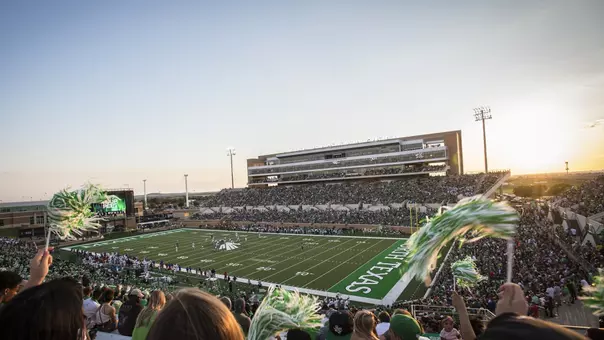
Villarreal didn't just get North Texas a new football stadium. He built a stadium designed by the architects behind the Dallas Cowboys' luxurious AT&T Stadium, a stadium that exceeds SMU's recently-built Ford Stadium, a stadium with giant video boards, luxury suites and club level, excellent facilities for broadcast and print media and a team apparel store. And it's massive wing-shaped end zone grandstands make it an iconic stadium.
More importantly, North Texas dramatically increased its student-athlete graduation rate, which rose 19 percent in the Villarreal era and exceeded that of the general student body.
All of which combined to lift North Texas to a higher-profile league in Conference USA.
Rick Villarreal leaves behind a revitalized, modernized athletic department, lifted out of its long dark ages and now on par with those in the region and in its conference, and one that gives its teams a chance at greater success.
Quite simply, Rick Villarreal did what I did not think possible at North Texas. And for that, I will forever be grateful.
(David Pyke is a 1982 graduate of North Texas, a Denton native and a life-long Mean Green fan, and has been a member of the North Texas Athletics Communications department for five years.)