
University of North Texas Athletics
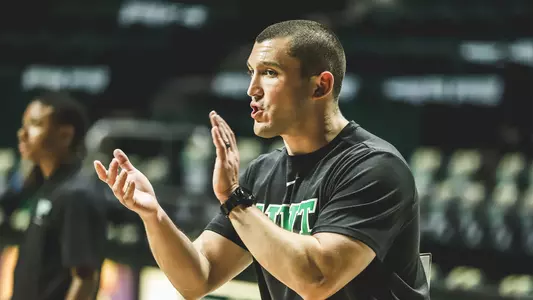
Photo by: Ben Stewart
Making Gains Through Adversity
5/13/2020 3:00:00 PM | Men's Basketball, Women's Volleyball
DENTON – During a North Texas men's basketball team practice in February, 6-foot-6 newcomer Thomas Bell soared in the air for a dunk that raised the eyebrows of everyone in the gym.
As soon as he landed, the team's strength and conditioning coach, Andrew Wright, emphatically turned to a group of support staff members standing by.
"I can't wait for the summer," he said. "Thomas hasn't even begun to reach his athletic potential.
"A full offseason of training in the weight room and he'll really be flying," Wright added.
What Wright couldn't have projected at that time is that in March the entire world was forced to change course as the coronavirus outbreak hit the United States.
After the dust settled and the heartache of not getting to see his 2020 Conference USA regular season champs have an opportunity to play in the 2020 NCAA Tournament, Wright had to adapt quickly. While the new normal had changed, the goals he set for his student-athletes this offseason had not. What he had planned for the UNT weight room was now going to have to be done at each individual's home and communicated virtually.
"Expectations don't change and I can't emphasize that enough," Wright said. "The standard is a championship at a minimum. The only thing that has changed is how we're going about it."
But how can a strength and conditioning coach help a student-athlete obtain physical growth without physically being there to see and train?
DEDICATION
To understand how he has kept the Mean Green in peak physical shape and maintained a championship expectation through all this, you have to know who Andrew Wright is at his core.
Along with men's basketball, Wright is the strength and conditioning coach for the UNT volleyball team.
Though the two sports' seasons only overlap for roughly a month in November and December, volleyball's offseason training happens during most of the spring semester and the middle of the men's basketball conference schedule.
Furthermore, due to their academic schedule the volleyball team trains during the offseason at 6 a.m. A typical February day for Wright consists of him arriving to campus in the wee hours to train volleyball. He then heads to men's basketball practice where he trains some players before practice and others after depending on their class schedule. If there is a home game, Wright can be in Denton until the late hours before heading home, which is a 40-plus-mile trek to Fort Worth.
"Coach Wright brings the same energy every day," said Mean Green men's basketball guard Javion Hamlet. "He pushes every one of his players to be great on and off the court."
Wright, who graduated from TCU in 2013, never worked for the Horned Frogs athletic department as a student strength coach. In fact he didn't know he could use his love for training with college sports teams until after graduation when he looked into being an intern.
And it was a perfect fit.
Growing up playing baseball, Wright loved being part of a team and missed that aspect of his life once he left his hometown of New Orleans for TCU. Like many coaches and administrators who work in college athletics, getting to be with 18 to 22-year-old student-athletes is a big part of what fuels Wright's dedication to his job.
"Every day I get to coach young adults in a sport they've devoted their lives to and develop relationships with those student-athletes," Wright explained. "It's those relationships that bring me back every day."
During this break in routine, Wright has called every one of his student-athletes a couple times a week to check in. Not only to see how they're doing with training, but how they're doing in all aspects of their lives.
"Yeah we talk about training but more than anything I like to ask them 'what's one thing that made you smile since the last time we talked?'," Wright said. "I love the kids and it's interesting hearing what they have to say."
CULTURE
Conference championships are not won by teams who have cracks and divisions within its team culture.
Wright has credited the improvements the teams have made this offseason due to their culture, which head coaches Andrew Palileo and Grant McCasland have built.
According to Wright, one of the biggest difficulties student-athletes are facing right now in addition to no hands-on training is their schedules are not as structured as when they are on campus, which can really hinder training.
However, he's at ease.
"Relying on the team culture has been the biggest piece," Wright says. "Every year I tell the teams that I won't teach effort. It takes us away from the actual training. And thanks to the teams' culture I know both teams share that commitment and I don't have to try and get them committed. I'm very fortunate to be part of two great programs."
THE WORKOUTS
When it became clear that Wright was going to have to virtually train his student-athletes during the offseason he surveyed the landscape.
He found out that only five of his 40 plus student-athletes had access to a barbell.
So he needed to find a way to be creative with the workouts and how he was he going to best communicate them.
"There's nothing we're doing that's really that unorthodox," said Wright.
He went on to explain that our bodies and muscles don't know if we have a basketball or volleyball in our hands or if we're working out in a gym or in a grass field. But as long as we are using our achilles, knees, hips and so on in an explosive manner this offseason, regardless of resources, it will transfer over positively during the season. So sprints and plyometrics have been crucial for both the men's basketball and volleyball teams.
What's also helped immensely during these times has been the generosity of Jim and Linda McNatt who donated resistance bands to UNT student-athletes to assist with their strength training this summer.
Wright said the bands have greatly helped fill the gap that many of the student-athletes were facing with training this offseason.
"I can't thank them enough," Wright said. "Next to our actual bodies, the bands have become our most important tool this offseason."
Technology has helped Wright communicate best with his student-athletes.
Along with calling them weekly, he sends them weekly suggested workouts in written form and has created a YouTube channel to give a physical demonstration of the workouts. With just his phone and some evolving video editing skills, Wright has made workouts as close to hands-on as possible. Furthermore, he says it gives the student-athletes that extra motivation and "juice" that mimics what they'd get if they were in a team setting on campus.
"I really miss having my team to push me when I am working out," said Mean Green volleyball's rising senior Barbara Teakell. "The workout plans coach Wright has given us have been an awesome gift that has enabled me to push myself and stay motivated to work for my team, even when I'm not with them."
As soon as he landed, the team's strength and conditioning coach, Andrew Wright, emphatically turned to a group of support staff members standing by.
"I can't wait for the summer," he said. "Thomas hasn't even begun to reach his athletic potential.
"A full offseason of training in the weight room and he'll really be flying," Wright added.
What Wright couldn't have projected at that time is that in March the entire world was forced to change course as the coronavirus outbreak hit the United States.
After the dust settled and the heartache of not getting to see his 2020 Conference USA regular season champs have an opportunity to play in the 2020 NCAA Tournament, Wright had to adapt quickly. While the new normal had changed, the goals he set for his student-athletes this offseason had not. What he had planned for the UNT weight room was now going to have to be done at each individual's home and communicated virtually.
"Expectations don't change and I can't emphasize that enough," Wright said. "The standard is a championship at a minimum. The only thing that has changed is how we're going about it."
But how can a strength and conditioning coach help a student-athlete obtain physical growth without physically being there to see and train?
DEDICATION
To understand how he has kept the Mean Green in peak physical shape and maintained a championship expectation through all this, you have to know who Andrew Wright is at his core.
Along with men's basketball, Wright is the strength and conditioning coach for the UNT volleyball team.
Though the two sports' seasons only overlap for roughly a month in November and December, volleyball's offseason training happens during most of the spring semester and the middle of the men's basketball conference schedule.
Furthermore, due to their academic schedule the volleyball team trains during the offseason at 6 a.m. A typical February day for Wright consists of him arriving to campus in the wee hours to train volleyball. He then heads to men's basketball practice where he trains some players before practice and others after depending on their class schedule. If there is a home game, Wright can be in Denton until the late hours before heading home, which is a 40-plus-mile trek to Fort Worth.
"Coach Wright brings the same energy every day," said Mean Green men's basketball guard Javion Hamlet. "He pushes every one of his players to be great on and off the court."
Wright, who graduated from TCU in 2013, never worked for the Horned Frogs athletic department as a student strength coach. In fact he didn't know he could use his love for training with college sports teams until after graduation when he looked into being an intern.
And it was a perfect fit.
Growing up playing baseball, Wright loved being part of a team and missed that aspect of his life once he left his hometown of New Orleans for TCU. Like many coaches and administrators who work in college athletics, getting to be with 18 to 22-year-old student-athletes is a big part of what fuels Wright's dedication to his job.
"Every day I get to coach young adults in a sport they've devoted their lives to and develop relationships with those student-athletes," Wright explained. "It's those relationships that bring me back every day."
During this break in routine, Wright has called every one of his student-athletes a couple times a week to check in. Not only to see how they're doing with training, but how they're doing in all aspects of their lives.
"Yeah we talk about training but more than anything I like to ask them 'what's one thing that made you smile since the last time we talked?'," Wright said. "I love the kids and it's interesting hearing what they have to say."
CULTURE
Conference championships are not won by teams who have cracks and divisions within its team culture.
Wright has credited the improvements the teams have made this offseason due to their culture, which head coaches Andrew Palileo and Grant McCasland have built.
According to Wright, one of the biggest difficulties student-athletes are facing right now in addition to no hands-on training is their schedules are not as structured as when they are on campus, which can really hinder training.
However, he's at ease.
"Relying on the team culture has been the biggest piece," Wright says. "Every year I tell the teams that I won't teach effort. It takes us away from the actual training. And thanks to the teams' culture I know both teams share that commitment and I don't have to try and get them committed. I'm very fortunate to be part of two great programs."
THE WORKOUTS
When it became clear that Wright was going to have to virtually train his student-athletes during the offseason he surveyed the landscape.
He found out that only five of his 40 plus student-athletes had access to a barbell.
So he needed to find a way to be creative with the workouts and how he was he going to best communicate them.
"There's nothing we're doing that's really that unorthodox," said Wright.
He went on to explain that our bodies and muscles don't know if we have a basketball or volleyball in our hands or if we're working out in a gym or in a grass field. But as long as we are using our achilles, knees, hips and so on in an explosive manner this offseason, regardless of resources, it will transfer over positively during the season. So sprints and plyometrics have been crucial for both the men's basketball and volleyball teams.
What's also helped immensely during these times has been the generosity of Jim and Linda McNatt who donated resistance bands to UNT student-athletes to assist with their strength training this summer.
Wright said the bands have greatly helped fill the gap that many of the student-athletes were facing with training this offseason.
"I can't thank them enough," Wright said. "Next to our actual bodies, the bands have become our most important tool this offseason."
Technology has helped Wright communicate best with his student-athletes.
Along with calling them weekly, he sends them weekly suggested workouts in written form and has created a YouTube channel to give a physical demonstration of the workouts. With just his phone and some evolving video editing skills, Wright has made workouts as close to hands-on as possible. Furthermore, he says it gives the student-athletes that extra motivation and "juice" that mimics what they'd get if they were in a team setting on campus.
"I really miss having my team to push me when I am working out," said Mean Green volleyball's rising senior Barbara Teakell. "The workout plans coach Wright has given us have been an awesome gift that has enabled me to push myself and stay motivated to work for my team, even when I'm not with them."

Players Mentioned

Forward
/ Men's Basketball
Guard
/ Men's Basketball
OH
/ Women's VolleyballBroadcast Highlights vs Rice | Mean Green MBB
Thursday, March 05
MBB Postgame Press Conference | UNT vs. Rice
Thursday, March 05
Broadcast Highlights vs FAU | Mean Green MBB
Monday, February 23
MBB Postgame Press Conference | UNT vs. FAU
Monday, February 23